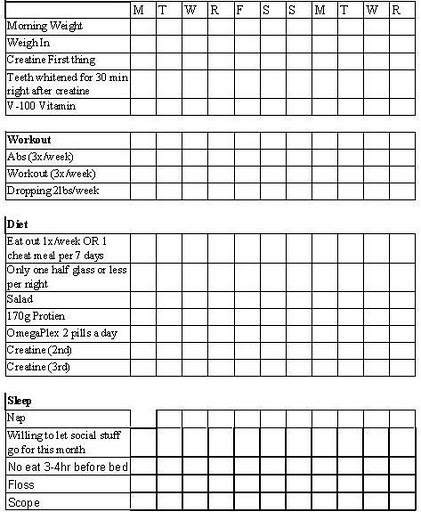
Non-workout days:
—
Jared Fielding


If you have good credit, the opportunities this year are quite a bit better than the ones from last year. I recently found & applied for the two best cash back credit cards I’ve seen available in a long time.
Over 18 months ago Schwab offered a cash back card at 2% for a limited time and the window closed before I could apply. It does not plan to re-offer the card and I’ve been hunting for a 2% cash back credit card ever since. Fidelity is offering two amazing deals, including a 2% cash back card, for an unknown period of time; act accordingly.
(Drum roll) Here are the best cash back credit cards for 2011 (and updated for 2013 — still the same!)
American Express Fidelity Rewards: Earn 2% cash on everything. The best overall credit card on the internet. Requires opening a Fidelity account online here (<3 minutes, no deposit required). Cash back rewards are transferred to the Fidelity account (can be transferred to your checking or automatically invested in an IRA or college savings account). You can setup the cards to auto-sweep to your account monthly assuming you have at least $50 (instead of yearly like Costco or until you have some minimum number of points). App.
VISA Capital One Rewards: Earn 1.5% cash back on everything. This is better than the Fidelity VISA card in two important ways: it doesn’t require a Fidelity account and instead of sweeping the money into an account, you can set it to auto credit against your future bill so you get immediate benefit instead of the bank holding your money. App.
VISA Fidelity Cash Rewards: Earn 1.5% cash on everything. Requires first opening a Fidelity Cash & Brokerage account online here (<3 minutes, no deposit required)). Cash back rewards are transferred to the Fidelity account which can be transferred to your checking or automatically invested in an IRA or college savings account. Be sure to give Fidelity account # to representative if applying by phone. App.
American Express Costco Business: Earn 3% back on gas up to $6,000, 2% on eating out, 2% on traveling, and 1% on everything else. They send a check out once a year with what you accumulated. App.
American Express Costco Personal: Earn 3% back on gas, 3% on eating out, 2% on traveling and 1% on everything else. They send a check out once a year with what you accumulated. App.
Amex SimplyCash Business: Earn 5% cash back on wireless service and office supplies , 3% on gasoline up $12,000 per year, and 1% on every other purchase. $100 annual fee (which eliminates a lot of its value for me). Plus, it is automatically credited to your statement each month. App.
American Express Additional Benefits:
Extended Warrenty: Extends the term of the original manufacturer’s warranty up to one additional year.
Damage/Theft Protection: Protects purchases against accidental damage and theft for up to 90 days from purchase.
Other Benefits here half way at bottom.
American Express is the best card to use for all new purchases particularly because it extends the warranty for free for a year, which has a lot of value. For example, extending the iPhone warranty 1 year costs an additional $70; an extended warranty on a new TV or other high end purchase is worth even more money. A friend recently had the water pump on his hot tub go out; it was outside the manufacturer’s warranty by 1 month. But it was covered by American Express, who cut him a check for $700.
Since American Express is not accepted at all places, particularly restaurants, there’s value in also having a VISA Rewards card.
VISA Bank of America Rewards: 3% gas, 2% restaurants, 1% everything else plus $50 cash bonus. App.
Summary: The difference between 1% and 1.5%-2% is is 50%-100% more cash back. It’s the difference between a $500 (at 1%) and a $750 (at 1.5%) or $1,000 (at 2%) for simply using a better card.
Avoid. Credit cards with “up to” language or that have rotating categories or other strings attached generally are games that lower total cash back at the end of a year.
Debit Cards. While I strongly dislike debit cards because they are more difficult to deal with in terms of fraud protection and offer less fringe benefits, below is the best cash back debit card available:
Mastercard PerkStreet Debit Card: 2% cash back on everything provided you maintain a $5,000+ balance. Less than $5,000, the reward drops to 1%. App.
These are the best deals I believe are available. If you’re aware of something better, please let me know.

This is an email I wrote to the author of The Simple Dollar in response to his article detailing an approach I think builds on his idea but I feel is much better.

The Simple Dollar: “Determining the Size of Your Emergency Fund” plus 1 more
|
|
One common question I get from readers relates to the size of their emergency fund. Simply put, how big should it be? How much cash should they have saved in their savings account for those unexpected events life deals you?
Before we even get started, it’s important to note that there are a lot of different theories and ideas about how big an emergency fund should be. The ideas that follow are largely based on my own experience and from the many stories that readers have shared with me over the years.
Also, never, ever have an emergency fund that consists of a credit line. Your credit card is not an emergency fund. A line of credit is given to you by a bank and they have the power to revoke that line of credit or reduce it, often at the very moment when you’re facing an emergency and need that money. Do notrely on it. It is not an emergency fund.
First of all, no matter what your situation, you should strive to have $1,000 in your savings account. If you’re trying to pay down debt, switch to minimum payments for a while and build up this level of cash on hand.
$1,000 covers the vast majority of the emergencies we face in life. It can handle most car repairs. It can handle many medical emergencies, particularly if you’re insured with a deductible of $1,000 or less. It can handle lots of smaller situations that you didn’t quite expect.
If you have high-interest debt, pay that off before building your emergency fund beyond $1,000. I would define high-interest debt as being any debt with an interest rate above 10%. If you are carrying a debt with an interest rate at that level, you need to get rid of that debt. It’s seriously hurting your finances if you let it continue to sit there and accumulate interest.
If you have only low interest debts, I would move that emergency fund up to two months of living expenses for your family. I would consider two months of living expenses to be the base level of money I would keep in your emergency fund.
What exactly is two months of living expenses? Sit down with your checking account and figure out how much you spend in an average month. The best way to do this is to add up all of your spending over the last year – all of it – and divide by twelve. That will give you your average spending for a month. Multiply that by two and you have two months of living expenses.
Of course, if you’re ever in a desperate pinch, you’ll probably cut your spending somewhat and the money will last longer than that. That’s fine, but you never want to assume how your future self spends money.
If you have dependent children, I would add another month of living expenses to your emergency fund for each dependent child. Of the items here, this is the one that I would most describe as personal opinion. Simply put, when you have young children, you need to do what you can to maintain a stable household for them. Children thrive in a stable environment. One big tool for maintaining that stable environment is a very healthy emergency fund.
Don’t invest your emergency fund money into anything that might lose money. Many people are disappointed in the returns that a savings account gives and want to put their money into other investments with a higher potential return. However, investments that offer a better return tend to lose one (or both) of the two key factors that make savings accounts perfect vehicles for emergency funds. Savings accounts don’t have the risk of losing money over time (often at the moment when you need the money) and savings accounts are highly liquid, meaning you can withdraw the money whenever you need it without penalty.
Yes, stocks might outperform a savings account over a long period of time, but on a given day, stocks can very easily be down significantly, which means that you may not have adequate resources during the very emergency when you need it. If you put money into something like CDs, where you’re not at risk of a loss and get a better return, you face the liquidity problem in that you can’t withdraw the money without penalty at the moment you need it. Stick with savings accounts for this purpose.
When you do choose to use your emergency fund, your first priority should be to replenish it once you’re back on your feet. This might mean turning off other savings plans or investing plans for a bit as you replenish, but this needs to be done as quickly as possible to protect yourself against subsequent emergencies.
|

 I recently learned I had made a mistake since car tires are one of the top variables in a smooth quiet ride.
2010 was almost a good year, until I invited Bree to our betting pool. She single handedly destroyed us all, piling up more wins that everyone else put together. It was an impressive betting year — many of the results were decided by less an 1%. Ah, well, there’s always 2012.
The full 2010 betting results are here: Election Results 2010
Round 1 & 2 Results:
12 Bree
6 Jared
5 Dustin
2 Marshall
1 Lynn

- Sabato: GOP to Pick Up 47 Seats
- RCP: Average Gain Up To 57
- Cook: Much Like 1994, 52 Seats
- Cost: Republicans Will Gain 61
- Silver: Odds Favor GOP, 49 Seats

I found a website that I hadn’t used before, which offers a deeper look at some of the data than realclearpolitics.com.
A summary of the stats from Pollster.com:
Obama on the Economy: -18% disapprove
Obama on Health Care: -10% disapprove
Obama (general): -5% disapprove
Looking at Obama from 3 points of view:
Obama (dem’s rating): +64% approve
Obama (R’s rating): -80% disapprove
Obama (Independents): -15% disapprove
It’s interesting to be able to see independents seperated from those who are “pre-determined.” I wish I could see health care ratings by R/D/Independent.
Party Affiliation (very interesting):
32% Democrats
35% Independents
25% Republicans
I had no idea R affiliation was so much less than D affiliation. That being said, R’s are probably more likely to be Independent (R’s are a more independent group).
RCP Generic Polling
+7.8 Republican lead
48% Republican Vote
41% Democrat Vote
What’s fascinating is if you look at historical data and see that the R’s are now where the D’s used to be (at the 48% level). Who’d a thunk it. In large part, I think it’s the economy. The D’s are in power and getting covered with the crap of a situation that’s not their creating. If the R’s were in power, it’d be the same thing.
Nothing particularly new to report. Wanted to “timestamp” some pol-stats.

The numbers for Democrats seem to be getting worse as time goes one. This is inline with my predictions at the beginning of this blog. Of course that doesn’t mean much since the election isn’t today.
If it was, however, it would be a bath.
The Gallup poll showing R’s leading D’s by +10 pts in the generic polling is the largest in Gallup’s polling history.
The Crystal Ball went on record to say that the R’s will pick up the House as almost a given, and the balance of the Senate is only slightly leaning D at this point. They have a 98% prediction track record over the last 10+ years.
Presently, the ElectionPrediction.com is calling for a equally large +9 Senate pickup (a smaller House pick-up, but still a R majority).
I prefer RealClearPolitics average which is a much more accurate picture than any single poll in my experience. This shows a (moving) average of +4.8pts – which seems a tad more grounded. However, given that R’s are much more fired up to turn out than D’s. When you factor in likely voter turnout, if the election were held today, it would be worse than the RCP average shows (something I’ve also been asserting). I think the recent prediction is probably a high-side analysis (ie, I think it’s reasonable, but stretching the slightly high side. The final numbers are unlikely to be much higher than this prediction). I think if it were held today, Senate would likely be +8 R.
Sabato commented that things can change and highlighted a few things that could sway things one way or the other. If the R’s have any brains, they won’t do anything significant. This is their election wave to ride – not to create. The current news – and more important, the upcoming economic news in my opinion – are likely to deteriorate. Since I watch real estate from the ground, having a double dip economy is something I’ve predicted since the announcement of the Stimulus Package. I see it not as “possible” or “likely” – more as a nearly foregone consequence of living on debt. It’s a question of timing at this point. The bets aren’t about will we have a double dip. The bets are trying to call how soon. That’s a 2012 issue in my opinion. For now, I see things deteriorating (not improving or even maintaining) from where they are, although probably not radically in the next 60 days. See the most recent unemployment/jobless numbers showing a slow negative trend.
Sabato’s projections are closer to what I see as likely on election day. I saw his previous projections as a tad conservative (which they were, by his own admission today). I’m comfortable in the +7-8 zone more than +6 or +9 at this point (today). I doubt it will get significantly better for R’s from +9; the pain could decrease quite a bit for D’s from here — but I don’t foresee that happening significantly. However, since I see things worsening, while I see +9 as a high-side today, it’s quite possible +9 will be “likely” in 60 days.
Still 60 days for change one way or the other.

 Jared Fielding